bookscene.ca Embraces the New Technology while Appealing to the Sensibilities of their Customers

I’ve had the awesome privilege of working with Directbrands.com, (parent company of bookscene.ca) in the last couple of years, introducing them to a medium that would help supplement their acquisition and retention efforts. While it started with educating them in social media, they were one client that came to quickly embrace it and realize the inherent benefits as it related to ROI. Along the way, social media became a strong channel to quickly gauge customer service satisfaction, test promotions, and alert the business to new insights about their most valuable customers.
This experience has opened their eyes to the possibility of launching a service, leveraging grass roots as a way to help build the business from the ground up – while maintaining and nurturing those key customer relationships along the way.  Rob Weatherall, of Directbrands, has been a true maverick for the brands he manages and has been open to developing and carving out a new channel to help drive marketing efforts.

For bookscene.ca, social media would prove to be somewhat of a challenge–bookscene.ca had a few barriers to contend:

  • For a new brand, it had little to no brand awareness
  • bookscene.ca had to brace itself against the mighty Amazon.com and Indigo/Chapters in order to hope to create some visibility within the Canadian book category
  • The advent of e-books and e-reader technology would be difficult to overcome given bookscene.ca’s core proposition: traditional hard and soft cover books

But bookscene has overcome these obstacles and has found a way to play in this category by differentiating its offering and its appeal to consumers. Through social media, bookscene has been able to really define itself in the Canadian marketplace and will continue to do so. The relationship began with a conversation, and it’s this enduring dialogue that will keep bookscene.ca appealing to consumers in a way that will build loyalty for their business.
Please read the full article on whatsyourtech.com. Bookscene.ca is officially launching September 29, 2010 at the Bata Shoe Museum, Toronto (link). Please RSVP to attend this event.
What the F**K is Social media NOW?

Aside from the profane title, this is an amazing presentation that was made known to me by @stevenltaylor  Thanks Steve!  My favourite slide is on page 45 that validates the voice of consumer OVER the corporate entity: 

  • BP’s official Twitter Account: 16,000 followers
  • vs Satirical (anonymously-run) BP Twitter Account: 180,000 followers

Remember the news item called “The TIFF tweet heard around the world?” It was not, according to the Toronto Star, the story about bedbugs infesting Scotiabank Theatre.”  It was a story about a rumour, one that was spawned by a suggestion of a bedbug infestation. This little itty bitty rumour proliferated to various blogs and news sites implying a “critter hijack” of one of the Toronto International Film Festival venues.

This is just a validation of this presentation. So, take note!

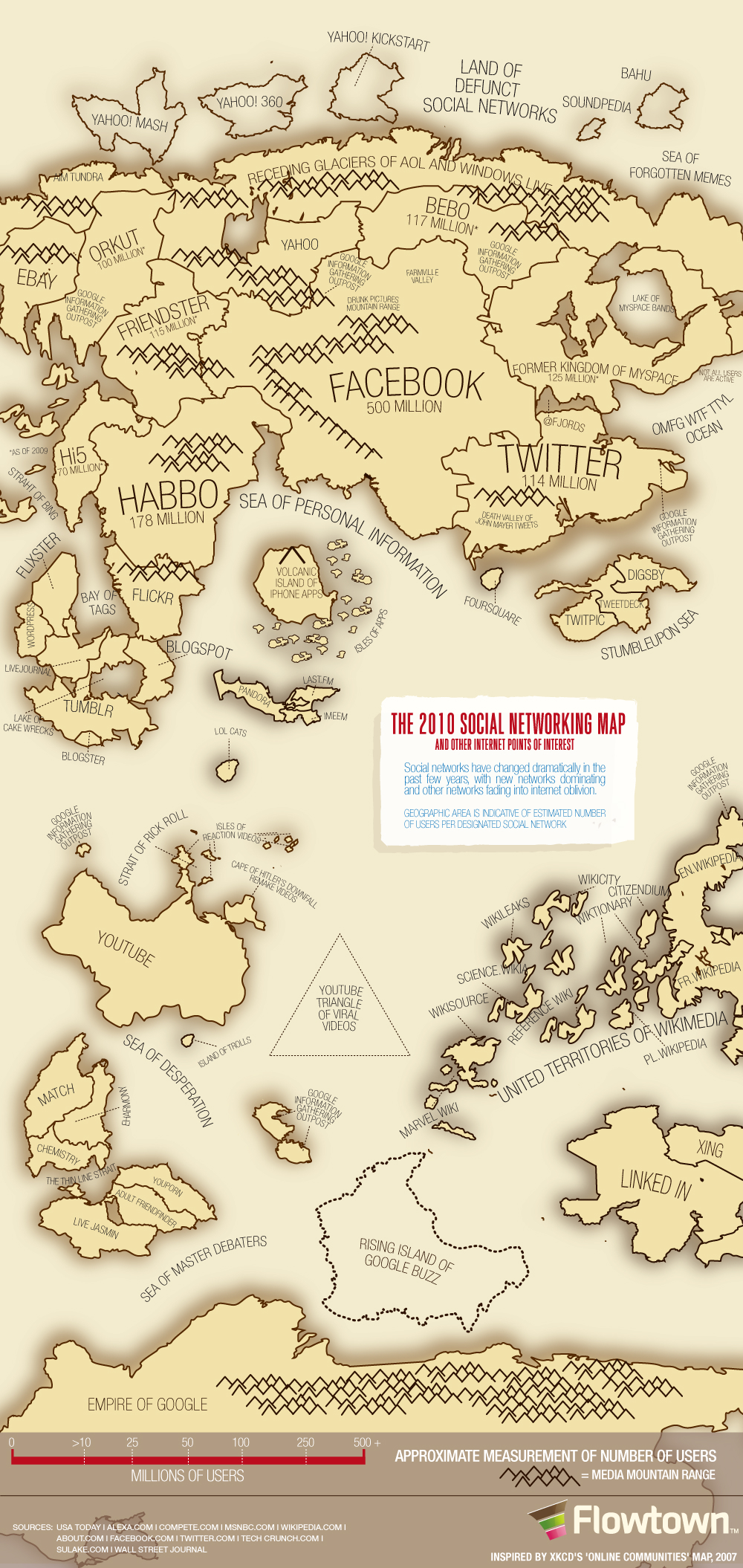
The 2010 Social Networking Map via @flowtown

I couldn’t resist adding this to my post for reference. I saw this on @flowtown earlier this week (here’s the original post) and asked them if I could have the original image for reference and to send out to my clients. It really makes you think about the increasing pace of changing relevance. It’s nice to know that Social Media has allowed the little guys to develop and not be sucked in “totally” by the dominant few.  Note how  Yahoo has been relegated to the “land of defunct”, as well as “the receding glaciers of AOL and Windows”.  Not long ago, these were the big guns…. and now they’re history. And where is Ning? hmmm…

The Segregated Internet: The Walled Garden that lives among an Open Source Internet Society

A few weeks ago, a few friends of mine, Steven Taylor @stevenltaylor and Martin Byrne @mbyrne2323 had a philosophical and yet cynical discussion about this growing notion of the “Splinternet” which was initally coined by Doc Searles and Rich Tehrani. Thanks to Josh Bernoff of Forrester for bringing this back to light. He referred to a “Web in which content on devices other than PCs, or hidden behind passwords, makes it harder for site developers and marketers to create a unified experience.” Steve was the one who first brought up this notion of the Walled Garden. While it seems we’re playing nice in the sandbox, there are big players who are slowly creating a greater separation for the purposes of wielding greater control in a largely uncontrollable market.

Social, while around for awhile, has been questioned by traditional marketers who need validation of its performance. What has helped unify social sites has been open source that allows the connectedness of platforms that have hoped would also provide more insight into consumer behaviour and navigation cross-platforms and channels. The notion of open source was sharing and allowing individuals to access multiple networks without relying on the management of multiple accounts. I have often parallelled this to the idea turning spaghetti into soup, where users go from site to site seemlessly, sharing same and new connections as they go and creating more bonded relationships.

At least this is how I envisioned the insertion of open source…

But Apple and Facebook, two extremely strong players are making it increasingly difficult to play nice. I’ve developed on Facebook pages and have experienced migraines at their ever-changing policies. Not to mention, Facebook code changes, implemented at the expense of the developer efforts and marketers’ investment dollars, are indicative of a communist regime that has no problems dictating policies, because they claim the population equivalent to the third largest country behind China and India.

Things that tick me off:

  • Facebook,’s policies on doing Facebook Page promotions need the written consent of Facebook.
  • Facebook bends the rules for current advertisers.
  • Marketers are unable to run contest and promotions utilizing Facebook’s native tools — their wall, photo tags, video etc for fear or liability in the event of a malfunction on these tools. This is what really P’s me off. I have been told to build my own “wall”. Well Facebook, that defeats the purpose of amplification if my wall posts won’t be fed into the newsfeed.
  • Facebook Community Pages, which totally confuse the user, and draws attention away from the official page.
  • Google no longer has access to index all web content. Newscorp and Facebook do not disclose all their content to Google.
  • Newspaper sites that closed down their offline are moving to online paid subscription, therefore perpetuating this separation.
  • I know Apple’s been pretty much doing the same thing with HTML5 as the rest of us have gotten used to Adobe Flash.

I actually love the idea of Open Graph that creates a social footprint for all web assets outside of Facebook or other social platforms. But that infers Facebook domination. Google watch out!  (another blog post methinks!)

All this is happening while people like me are still trying to validate the channel. Standardization has still not happened. The IAB doesn’t know how to treat metrics, best practices, etc. The closer we get to creating a stronger community, the harder these companies are working to remove themselves from the mix.

I guess in some ways, if truth be told, there needs to be a few that dominate. Does Apple and Facebook want to be the MSN and Yahoo! during their heyday? And what will happen to the true value of open source? I’m compelled to believe that the masses may demand some sort of conformity but I doubt that will wield any long term effects.

So, I guess we’re witnessing the end of an era….however short-lived!

Here is a recent video that explains this.