The Internet Economy will only Survive with Proper Privacy Disclosure

I recently wrote a post in What’s Your Tech entitled: Google vs. Facebook: It’s all about Privacy.

My background is in database marketing and I am a firm believer in full disclosure to the consumer. This has been the practice for any one-to-one communication regardless of channel. It’s the reason why loyalty programs, direct mail even telemarketing have been strong purveyors of communication and insight.  Transitioning this principle to the internet should not change the principles. In fact, given the amount of information that people are creating and sharing on these social platforms should leave all of us to question how some of this information will be used.

Two additional news items came to light in the last few days:

Given the amount of media scrutiny on this issue, Twitter is actually taking a proactive step in identifying apps that may have access to user information, specifically DM, and taking steps to properly inform users within the OAuth session. At the same time they are mitigating any future access from apps by eliminating the DM data. Smart move and good for Twitter for staying under the radar on this one!

The bill (SB 242) would prohibit Facebook and other social networking sites from publicizing users’ addresses or phone numbers without their explicit consent.” Not surprisingly , Facebook, Google, Twitter, Skype, and Yahoo, among others have banded together and denounced the bill calling it unconstitutional and hurting tech companies and negatively impacting the internet economy .

I don’t buy it. In fact I think the more these platforms keep from the consumer, the harder it will be to garner performance from advertising.  I also disagree with the argument that the common user does NOT understand how they’re data is being used, nor do they care.  The amount of media attention to this topic has certainly been enough to convince the people around me that they have to really manage what they share and don’t share. Why not give the users the benefit of the doubt? Are companies afraid that “consumer knowledge” will render their platforms less attractive to marketers?

Coming from the banking industry and from a country that is relentless in protecting user information, while there are limitations there’s an even larger negative impact on the business: reputation and eventually…. churn. From a customer viewpoint, “If you protect my information and you are up front with me about how you use it, I will trust you more”. I’ll take it one step further….”I will tell you about the things I like, don’t like, when I want to hear from you and in what channels”.  “If you go behind my back and you use my information that I haven’t given you permission to use, then our trust is broken and I will have one foot out that door”.

I worked for Yahoo! and I know the billions of ad dollars to be made is in tracking user behaviour: what they search for, where they spend their time, how recently … all this in order to offer targeted ad messages that provide real relevance for the user. To do this, cookies were absolutely essential. But Yahoo! was also adamant that external networks didn’t infringe their own cookies on the Y! user base so from that perspective they were “protecting” their users. Yahoo! openly disclosed this in their Terms of Service.

But Yahoo! and many of the Internet giants need to be more transparent in their disclosure and more user friendly.  Do-not-call List or Permission Marketing has NOT killed Telemarketing, Direct Mail or Email marketing. In fact the opposite is true: The final opt-in base may be smaller but the performance will be better. This will also hold true for the web.

What’s your opinion on this?

Next Generation Media Quarterly January 2011

Here’s @DanCall1’s latest Next Gen Media.
Some interesting highlights:
– Apple makes 60% of revenue from products that didn’t exist before 2007
– China has 842M mobile subscribers
– in African it’s close to half a billion, making up 10% of global mobile subscriptions
-“Call of Duty: Black Ops” was the biggest launch in entertainment history
-Angry Birds was downloaded 50M times in its first year
… plus a whole whack of new developments on Facebook
enjoy!

Happy Rambles … a Great Start for a New Year

The start of a new year brings with it a time of introspection, some nostalgia and many more regrets. We aim to do better this year– be healthier, be more patient, be kinder…. be happier.

And regrettably, we fail even before the snow melts into spring. It’s not because we didn’t try or we’ve lost commitment. But we are always so wrapped up in the “event” of the moment that we are not aware that we fell back on our promise to ourselves. We either choose to ignore the minor aberration or we fortuitously put it on the back burner, promising to revisit it again, and “this time” make it stick.

I do this every year. And every time I yell at my kids to hurry up before I miss my train .. or show impatience with my son for not getting his homework… or tell my husband that he doesn’t do enough around the house…. I kick myself for not being able to control my emotions mid-stream. Afterwards, the guilt sets in and I berate myself promising to take a “chill pill” and “be less mean”. Typically the process follows: I apologize to the recipient of my attack then I hug them with all my might while I wail with guilt, promising that I’ll handle it better the next time.

Well, it is 2011, the start of a new year and I promised myself that this is the year to change. I don’t feel so neurotic as I read Elizabeth Gilbert’s “Eat, Pray, Love” and I realize I am not so alone for feeling like I’ve failed in this part of my life.

Then the email came from a friend of mine, Faisal Sethi, who I consider a constant innovator, a great creative mind with an incessant passion to venture into new territories and challenge himself. In the past year, Faisal’s program Do-Good (an ad blocker technology in support of good causes) gained traction and was featured in TechCrunch.

Faisal recently sent me a note touting his new site: HappyRambles. The mission of the site: create and maintain a gratitude journal for life. People who maintain a gratitude journal are healthier, more optimistic, and more likely to make progress toward achieving personal goals.

I asked Faisal how he came to start Happy Rambles. “The past couple of years have been challenging for me. I got married, mortgaged a house, quit my job, started up (and shut down) a social enterprise, and had my father move in with us. I’ve been watching him slowly wither away from cancer, diabetes, and dementia. Needless to say it has been extremely difficult, and frankly, has made me feel down in the dumps for a time.

So, I started doing some research on happiness. What is it? How do we attain it? How can we sustain it? And voilà, Happy Rambles was born. I’m happy to say it’s been working for me. :)”

This reminded me of Neil Pasricha’s TedTalk on 1000 Awesome Things. Sometimes we find strength and hope even in our lowest moments and Faisal found a glimmer of light and he hung on to it… and now he’s brought it to the rest of us.

In his research, he came across the following findings: people who maintain a gratitude journal (vs those that do not)
• Are 25% happier
• Are 25% more energetic
• Show 20% less envy and resentment
• Sleep 10% longer each night
• Wake up 15% more refreshed
• Exercise 33% more
• Show a 10% drop in blood pressure
• Are 25% more altruistic
• Can produce positive effects that last up to 6 months
• Add up to 9 years on their lives
• Have higher grades and occupational attainment (happier students are earning $25,000 more 10 years after graduation)

This was enough motivation to get me starting my own daily journal. And it keeps me committed. Every night Happy Rambles will email me the question “What are you grateful for today?” I can reply with three to five things and my entry is immediately stored in my own private, secure and personal online gratitude journal. Today I put up my first post

“I am grateful for my husband and kids. Family is what makes it easy to get out of bed every day and tackle challenges. They are the reason that I am so adamant that I will be more patient, more loving, and as my husband says, “be less serious, and have more fun”. My outlook in life needs to change. This is my promise to myself this year… and going forward.”

I still say this is the first day of the rest of my life. Maybe I can go forward a little bit more positively and with less regrets.

Thanks Faisal!

By the way, to connect with Happy Rambles, Faisal sent me the following links: Blog, Facebook, Twitter

And I encourage you to “Ramble on”!

The Merging of Pure Play Media and Social Media

Why social rocks?

My first foray into social media some years back, I was confronted with a channel that seemed so vastly different than what I’ve come to know in my years as a digital marketer. I became enthralled with the notion of relationships driving business; with transparency and authenticity integral to delivering value. 

Willy Loman’s character in Death of a Salesman is about a man who is self-obsessed with the notion of greatness, and even in his later years convinces himself that success is directly attributed to “greatness, popularity and personal charisma”.

Contrary to that notion, many successful businesses have been built on a simple handshake, the unspoken trust built from years of understanding customers and responding to their needs. Customer relationships have been at the core of convergence. This is not new… but in the digital space, it is the absolute core to business sustainability.

And I have bought into that. I have come to emerge as a purist in social media and while I understand this continues to be a test and learn channel, I have not necessarily given up the principles that have accompanied the true merits of this channel: credibility, community, engagement and its undeniable result: sustainability.

Nowadays you can buy social… but that’s counter-intuitive to why social exists

In recent instances I have come into contact with social networks that have tried to sell me media across blog networks, consideration into networks with strong exposure to the long-tail audience.

While that piqued my interest, it became apparent that “access” to niche bloggers, particularly ones with influence, would really mean buying ads on their sites. There was no real opportunity to engage with these influencers, nor develop a really strong program to build brand engagement among the follower base. It was simply pure play media. The argument that comes back to me from the media sales guy, “…but it’s still media, and it doesn’t come free!”

The Quest to Monetize Social Networks

It seems to have been the age-old question. If these networks are to exist and be maintained, how are they going to make money? One of the reasons that Yahoo! reduced its investment in 360, Geocities, and Answers was that it struggled to combine online ads into a user-engagement environment ie the two environments could not effectively co-exist. Ad performance was poor because users didn’t want them there. There are some networks doing an ok job at monetizing the medium:

  • Google fortuitously recognized a subscription model that users were willing to pay for to help justify their acquisition of YouTube.
  • Slideshare and Scribd expect users to pay to maintain their presentations ie brand presence on its network. Downloads lead to business leads, hence the reason to be here.
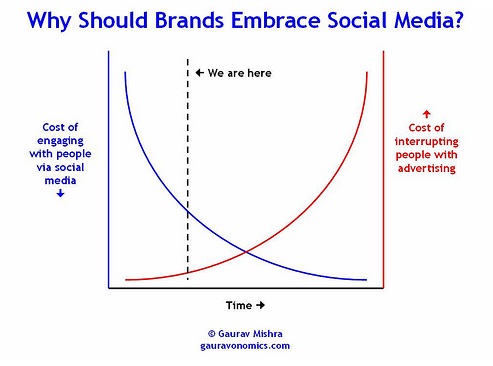
  • The contextual advertising Facebook offers is very relevant to its members, however I don’t know how good the click-through rates are compared to traditional online media. I would suspect that the low CPMs indicate that it’s still not a pervasive medium to buy ads. I’d like to be proven wrong on this one. My friend at Facebook and I have had endless arguments about social ads and the oxymoronic way Facebook has chosen to monetize its network. I argue it’s still blatant advertising and it’s the reason people have gone away from the portal model ie Yahoo! AOL and MSN — to get away from the intrusiveness that has come between the user and his/her consumption of content.
  • Twitter’s model is, by no means, relevant to its users. Twitter ads run in the user’s timeline and does not target users based on profile, interest, tweets or followers. This article, states, “ We want to display Promoted Tweets in a way that’s both useful and authentic to the Twitter experience”. IMHO authentically spamming.
  • I’d be interested to hear what other people think. Do we expect that emergence of more ads in our social footprint will be accepted by users in the long run? Or will it necessitate yet another change that undermines this trend?