The Changing Workforce: Social Media and Engaging with Employees #cdniabc12

In a space where social media has infiltrated our companies, at first by choice; later on, by the strength of external voices, it’s become increasingly clear that social media is no longer just a marketing and PR channel. It is a force that impacts all levels of the organization. It is no longer about being aware of what’s happening, but about effectively managing the message to desired outcomes.

On November 1-3, 2012, The International Association of Business Communicators (IABC), a global network committed to improving organizational effectiveness through strategic communication, will host the IABC 2012 Canada Business Communicators Summit, Trends 2013 at the Chateau Laurier in Ottawa!

One of the hot topics will be presented by Jackie King, Vice President and Group Leader, Change and Internal Communications Hill & Knowlton Strategies, is Customizing Internal Communications for the Modern Workplace, Particularly During Times of Change

This important session provides some pretty key insights about “exploring the importance of connecting with, and engaging with various internal stakeholders particularly within today’s corporate reality of downsizing/rightsizing, mergers and acquisitions, and transformation at the operational and leadership levels.”As the session indicates, where technology changes ever so rapidly, where real time discussions are having more impact on the business, where the global economy is moving towards more efficiency, it is becoming more critical to transform processes to maximize effective communication.

“Agility is a competitive advantage. As companies refocus their strategies to meet new conditions, success will be determined by the speed of adoption.”

In order to make this happen, the transformation needs to be made at the employee level. “Engaging employees is more than just a feel-good exercise – it’s about influencing attitudes and behaviors to drive bottom-line results.”
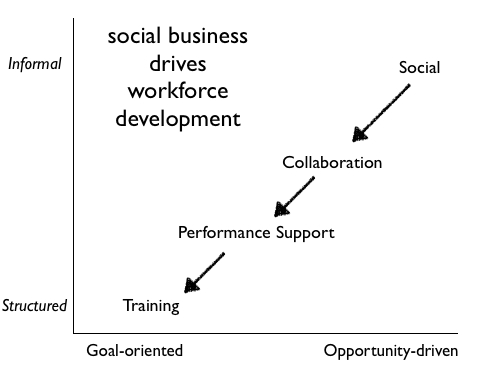

I recently wrote an article called, Do or Die: The Inevitability of Social Business. What Jackie sites as important changes to the organization will impact three levels (reference: Humanize by Maddie Grant and James Notter)

  1. Culture
  2. Process
  3. Behaviour – at the individual level

In this post, I pointed out, “Can we effectively align the workforce to operate cross-functionally, break down silos, and more importantly, come to a consensus?” This is difficult if departments have different goals and objectives. Let’s compound that with having to design a dynamic model that flexes based on customer outcomes. Now, we’re changing the way we integrate external information, and we’re paying heedance to the value of that information that pummels our organization daily… in volumes… and in real time.

These changes that Jackie King will reference are not easy, by any means. A mindset shift, decentralization of information and the ability to assign control to the employees will be necessary to help manage and potentially scale the communication. This is one session that’s not to be missed.

Other highlights from the conference that are must-sees:

  • The Power of Internal Branding: The Communicator’s Secret Weapon, by David Grossman, ABC, APR, FCPRS, Founder and CEO of The Grossman Group
  • Content in Context and the Content Marketing RevolutionJonathan Harris, Managing Director at Infomart and VP Business Development, National Post
  • Examining the Prime Minister of Canada’s Media Relations in a 24/7 Media WorldDr. Alex Marland, Associate Professor, Memorial University of Newfoundland.
  • Somebody We Used to Know: Reputation Management in the Age of Social Media, Martha Muzychka, ABC, Principal, Praxis Communications

For more information on this conference, please click here. Early Bird Prices in effect until October 11, 2012.

Image reference: http://www.jarche.com/wp-content/uploads/2012/03/social-drives-training.png

Role Models: Giving back means being another’s inspiration

I was privileged to ask to speak at the UFSC International Conference this weekend. The UFSC  is The Urban Financial Services Coalition is “the premier networking, professional development and community outreach organization for Black and other financial services professionals from diverse communities”. Their mandate is to:

  • Engage the talent in our community to develop professionally and seek their potential
  • Inspire young people to consider financial services as a viable career path
  • Inform our community about the importance of financial literacy to sustained prosperity
  • Empower all our members and constituents to reach new heights of leadership, personal growth and community service

As a panel member I spoke about the role of role models and what has inspired me in my life. It was great to hear the stories of panel members who had grown up in challenging circumstances and were able to go on and do amazing things with their lives, in spite of all the barriers they faced.

In my own life, I never really thought about my obstacles as obstacles. To me, they were just milestones I had to overcome. I listened to a gentlemen as he spoke about the challenges of the Black community and the years of suppression they had experienced. It was because of this history that he declared was the cause of the poverty and disenfranchisement Blacks had faced for decades. He was quite articulate as he stated that it was only “right” to give back to a community who have been marginalized and not granted the rights and freedoms compared to other communities.

One of my fellow speakers, Dwayne Matthews, Executive Director of d&a Canada, posed a controversial statement when he noted that he did not believe in giving back as much as “strengthening the weakened”, through mentorship, advice and training. Monetary gestures are not enough to fix the problems, nor motivate the youth.

I spoke up, as a daughter of immigrant parents. My parents came from the Philippines and were well-educated, both having received university undergraduate degrees before they married. When my parents decided to come to Canada, they brought with them 4 children under the age of 4. They struggled for years making ends meet. My father had to go back to school to get his Canadian university equivalency before he could even hope to try for an accounting designation. My mother always wanted to be a flight attendant. When they came to Canada, those dreams would never be realized. My father worked by day, then at night as a janitor, while studying for his accounting courses on the weekend. My mother took whatever work was available– remember Woolco?– to help supplement their income. We lived in a semi-detached home in Sarnia–I shared a tiny bedroom with my 2 sisters.

Growing up, we lived with racism, being one of only a handful of visibility minorities in a very white community. It was tough but we got through it. My parents were very protective but they always pushed us to study hard and get good grades. And we did. That was one of the ways we gained acceptance. My parents wanted us to live our own dreams even if they couldn’t.

My point is, while the gentlemen who challenged us about giving back, the obstacles of poverty and racism in my own life were overcome, not by others who “gave back” but by my parents’ incessant will to make sure we strove for something “better”. They instilled that in me and my siblings.

I didn’t really have any real motivation to be successful. That was ingrained from my parents at a very young age. I became who I am because of them. And when they weren’t around, I surrounded myself with “like” minds to accelerate my growth. That’s what my parents taught me.

I graduated university during the recession and it was difficult to secure employment for most of my graduating class. While I was lucky to secure a direct marketing position, no one seemed to be registering for seminars and conferences during this time. So, I moved from department to department until I was laid off. I took another job with an event company just to ride out the recession.

Then I landed my dream job at Ogilvy. Wow, 10 interviews later and I was in! And I held my head up high! I finally made it–or so I thought. It took me less than 3 months to realize how cut-throat the agency world really was. The notion of “you’re-only-as-good-as your-last….” was a common mantra. It was also a dog-eat-dog industry. Only the toughest survived. I battled a lot of frustration and politics in my career. I’ve unwittingly gone into battle with opponents much stronger than me. The tone of someone’s voice was enough to quell my spirit, crush my motivation and make me want to crawl underneath a rock.

I survived because of a mentor, Sandy Williams, a big ad executive who ran her own shop. Sandy had the patience to teach me about the ad industry: how to survive the insanity and the politics; the ins and outs of good creative; the essentials of production environment; and most of all, how to carve my own path.

The best advice I ever received from Sandy: When listening to someone who is visibly frustrated and angered by you, allow them to scream and vent. In the meantime, close your eyes and attempt to take away the “tone” of voice you hear and concentrate on the message they’re trying to get across. Use this as a guide to help you learn.”

This has gotten me through some tough times. I’ve grown stronger but promised myself to lead with integrity and motivation instead of fear. It’s the only way I can inspire others to learn to trust their own instincts and carve paths of their own.

This is probably the most important gift I could give. Am I a role model? I’m glad I’m perceived as one. I’m learning to trust that as far as I’ve come, I’ve learned a few things along the way–things that I must share. There is no point keeping it to myself if I can somehow have even an infinitesimal effect on someone else’s path to success.

I am forever thankful for my parents and people like Sandy that I’ve met along my journey. You have given me the knowledge and the strength to trust myself and what I’m capable of becoming. I hope I can do the same for others.

inspiration art exhibition part 2, originally uploaded by bwrahbwrah jonguh.

Personal Branding comes to Infographics: Introducing @Piktochart

So, it was time to update the CV and I passed on my mundane 8-page resume to a recruiter. It read like a book, and anyone even wanting to know about me would not even get passed the first page. The recruiter was blunt and told me I was in dire need of a major clean-up on my resume. I would have to hire a professional resume builder or somehow figure out how to maximize my profile–on my own.

Then I ran into a friend, @carmineporco who directed me to a site called Piktochart. So, I thought especially for those archaic recruiters who don’t go to LinkedIn, and still need to see the standard CV, this is a great way to spice up your profile: your CV in pictures.

Piktochart is a really simple interface: It’s all drag and drop. You can upload images, choose from many different templates that include cool charts and graphics. It’s perfect for people, like me, who have no real design experience. Edit and save your work online and download it as a .PNG file. Try it out for free.  You get 5 different templates to choose from and are only limited to 5 image uploads. Plus, you’re mandated to include the Pictochart watermark. But for $29 per month, you get 80+ themes, unlimited image uploads, better customization and the option to exclude the watermark.

Take a look at my CV below. This one took me about 8 hours – only because I was picky about the colours and how I wanted to present the information. Try it out! It’s awesome!

I’m just getting started….

The last 4 months have been a whirlwind and I’ve come to reflect on where I’ve been and where I am today.

I have been tapping into social media since my Yahoo! days and I’ve come to really love the medium. It goes against the grain of me as a traditional marketer, whose thinking has really been about creating excitement for products that people may not really care about initially, enticing a not-yet-established motivation to want the thing I was selling and provoke action.

I worked in credit card marketing for 6 years (sigh!) not fully believing that people really wanted credit cards, let alone debt. But as a marketer, I sold the notion of  access to ‘dreams’ if people had the vehicle necessary to get that access. As an advertising executive, I created amazing campaigns for products and services pushing messaging to audiences, at times, who clearly weren’t interested. The ones who were, were not deemed ‘ideal’ so I backed off from these seemingly low hanging fruits.

As I look back at these events, I realized the huge thing that was lacking: consumer validation… not sales, not response rates. In banking, a 2% response rate on a $4MM campaign was considered successful. That’s because that 2% audience could be upsold, cross-sold, and generate enough revenue over their lifetime to justify the initial acquisition cost.  But were the customers ever satisfied? Were they ever really happy? I never really knew because my access to the customer was nonexistent. I usually received a report from operations telling me how many people signed up for a credit card. Yay! But really?

As social media started emerging as a strong vehicle about 5 years ago, I paid close attention to its lure. Here, these networks existed without the interruption of annoying advertising. Ironic, cause I was typically the source of that annoying advertising. Slowly but surely, I also was lured to a space where people could speak as people, uninterrupted. I spoke to esteemed bloggers and social media strategists like Alejandro Reyes and Joselin Mane, who taught me the importance of active listening, transforming the marketing mindset, and leveraging relationships with the customer to truly succeed.  Even in MySpace days I talked with people who were just struggling to succeed. I knew a few band members who would develop new tracks every week so they could showcase it to their networks! And they received accolades and validation–albeit from a tiny universe who admired and appreciated their efforts.

That’s when I become a purist–not overnight but soon after. I became the anti-marketer, espousing authenticity, transparency, relationship-building.  I would talk to anyone who would listen, as if it was an epiphany moment! And it was! When I started blogging 4 years ago it was merely an outlet for me to verbalize where this all would lead: social, emerging technology and why it would change the way companies operate. Along the way, it also provided others, who stumbled upon my posts, an opportunity to learn. That was pretty cool… and that’s what kept me going.

I worked at start-ups, which help me delve deeper into social and the more I learned the more I became enamoured with the business possibilities for social.  I then moved to agency and ironically it was more difficult to sell the notion of social media (despite its increasing pervasiveness) to businesses beyond Facebook and Twitter. Businesses still wanted to control the message and chose to ignore the less-than-palatable public opinion. Embracing social means being able to take the good with the bad and it’s gonna take time before this happens especially in Canada.

So today I am at an amazing company that is in sync with where this world is going… where I believe it can leverage the social web’s strength. Jugnoo.com is doing some amazing things. I’m happy to be part of it. I’m working with some really amazing people. It’s a stacked team headed by a real visionary.

Stay tuned……we are just getting started!