The Merging of Pure Play Media and Social Media

Why social rocks?

My first foray into social media some years back, I was confronted with a channel that seemed so vastly different than what I’ve come to know in my years as a digital marketer. I became enthralled with the notion of relationships driving business; with transparency and authenticity integral to delivering value. 
Willy Loman’s character in Death of a Salesman is about a man who is self-obsessed with the notion of greatness, and even in his later years convinces himself that success is directly attributed to “greatness, popularity and personal charisma”.

Contrary to that notion, many successful businesses have been built on a simple handshake, the unspoken trust built from years of understanding customers and responding to their needs. Customer relationships have been at the core of convergence. This is not new… but in the digital space, it is the absolute core to business sustainability.

And I have bought into that. I have come to emerge as a purist in social media and while I understand this continues to be a test and learn channel, I have not necessarily given up the principles that have accompanied the true merits of this channel: credibility, community, engagement and its undeniable result: sustainability.

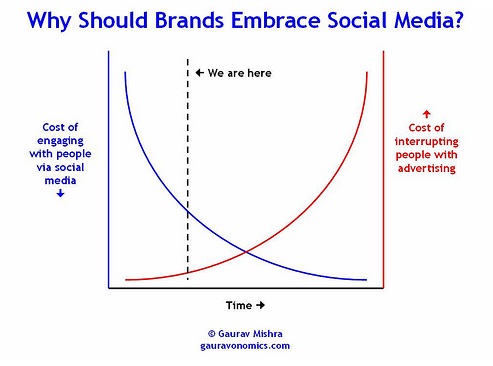
Nowadays you can buy social… but that’s counter-intuitive to why social exists

In recent instances I have come into contact with social networks that have tried to sell me media across blog networks, consideration into networks with strong exposure to the long-tail audience.

While that piqued my interest, it became apparent that “access” to niche bloggers, particularly ones with influence, would really mean buying ads on their sites. There was no real opportunity to engage with these influencers, nor develop a really strong program to build brand engagement among the follower base. It was simply pure play media. The argument that comes back to me from the media sales guy, “…but it’s still media, and it doesn’t come free!”

The Quest to Monetize Social Networks

It seems to have been the age-old question. If these networks are to exist and be maintained, how are they going to make money? One of the reasons that Yahoo! reduced its investment in 360, Geocities, and Answers was that it struggled to combine online ads into a user-engagement environment ie the two environments could not effectively co-exist. Ad performance was poor because users didn’t want them there. There are some networks doing an ok job at monetizing the medium:

  • Google fortuitously recognized a subscription model that users were willing to pay for to help justify their acquisition of YouTube.
  • Slideshare and Scribd expect users to pay to maintain their presentations ie brand presence on its network. Downloads lead to business leads, hence the reason to be here.
  • The contextual advertising Facebook offers is very relevant to its members, however I don’t know how good the click-through rates are compared to traditional online media. I would suspect that the low CPMs indicate that it’s still not a pervasive medium to buy ads. I’d like to be proven wrong on this one. My friend at Facebook and I have had endless arguments about social ads and the oxymoronic way Facebook has chosen to monetize its network. I argue it’s still blatant advertising and it’s the reason people have gone away from the portal model ie Yahoo! AOL and MSN — to get away from the intrusiveness that has come between the user and his/her consumption of content.
  • Twitter’s model is, by no means, relevant to its users. Twitter ads run in the user’s timeline and does not target users based on profile, interest, tweets or followers. This article, states, “ We want to display Promoted Tweets in a way that’s both useful and authentic to the Twitter experience”. IMHO authentically spamming.
  • I’d be interested to hear what other people think. Do we expect that emergence of more ads in our social footprint will be accepted by users in the long run? Or will it necessitate yet another change that undermines this trend?
    Next Generation Media Quarterly October 2010

    I always enjoy these reports that Dan Calladine @dancall1 always puts together.  It culls together some of the most notable industry data to give a great snapshot of media consumption and trends.  thanks again Dan!

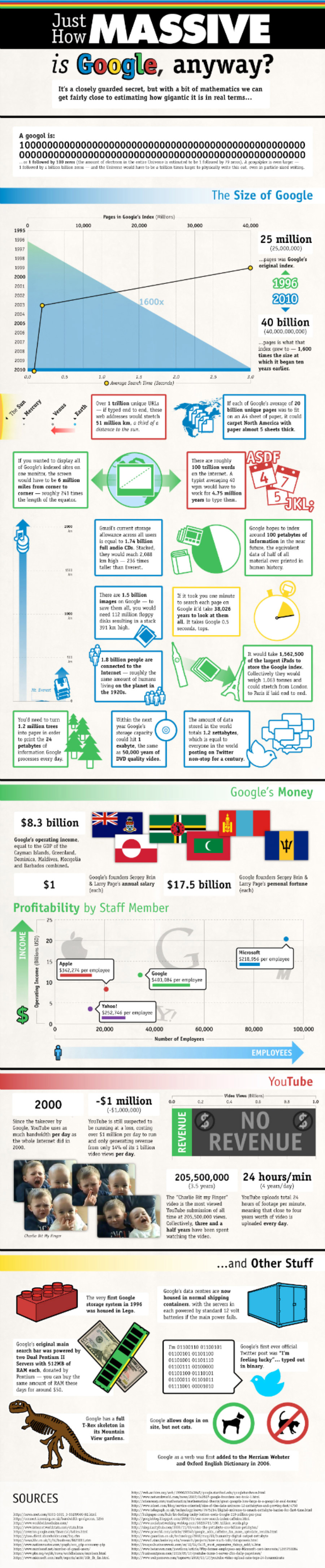
    Just How Massive is GOOGLE Anyway? [INFOGRAPHIC]

    I saw this from an email from @dancall1 and thought I’d post it for reference purposes. Remember how Facebook was compared to the third largest country? In this infographic, “Over 1 trillion unique URLS, if typed from end to end, these web addresses would stretch 51 million km, a third of the distance to the sun”. Freaky!


    bookscene.ca Embraces the New Technology while Appealing to the Sensibilities of their Customers

    I’ve had the awesome privilege of working with Directbrands.com, (parent company of bookscene.ca) in the last couple of years, introducing them to a medium that would help supplement their acquisition and retention efforts. While it started with educating them in social media, they were one client that came to quickly embrace it and realize the inherent benefits as it related to ROI. Along the way, social media became a strong channel to quickly gauge customer service satisfaction, test promotions, and alert the business to new insights about their most valuable customers.
    This experience has opened their eyes to the possibility of launching a service, leveraging grass roots as a way to help build the business from the ground up – while maintaining and nurturing those key customer relationships along the way.  Rob Weatherall, of Directbrands, has been a true maverick for the brands he manages and has been open to developing and carving out a new channel to help drive marketing efforts.

    For bookscene.ca, social media would prove to be somewhat of a challenge–bookscene.ca had a few barriers to contend:

    • For a new brand, it had little to no brand awareness
    • bookscene.ca had to brace itself against the mighty Amazon.com and Indigo/Chapters in order to hope to create some visibility within the Canadian book category
    • The advent of e-books and e-reader technology would be difficult to overcome given bookscene.ca’s core proposition: traditional hard and soft cover books

    But bookscene has overcome these obstacles and has found a way to play in this category by differentiating its offering and its appeal to consumers. Through social media, bookscene has been able to really define itself in the Canadian marketplace and will continue to do so. The relationship began with a conversation, and it’s this enduring dialogue that will keep bookscene.ca appealing to consumers in a way that will build loyalty for their business.
    Please read the full article on whatsyourtech.com. Bookscene.ca is officially launching September 29, 2010 at the Bata Shoe Museum, Toronto (link). Please RSVP to attend this event.