Did you wonder what it would be like to meet Twitter in person?… or Google? I saw this today on Twitter and I had to share it! Enjoy!

....cause there's something to say
Did you wonder what it would be like to meet Twitter in person?… or Google? I saw this today on Twitter and I had to share it! Enjoy!
Imagine browsing the web and being able to see ad content that appeals to you…not on one site but multiple sites you go. It’s as if the web had this sixth sense….reading your mind, appealing to your preferences…not necessarily forecasting your next move based on your past behaviour but understanding you and what you want to see.
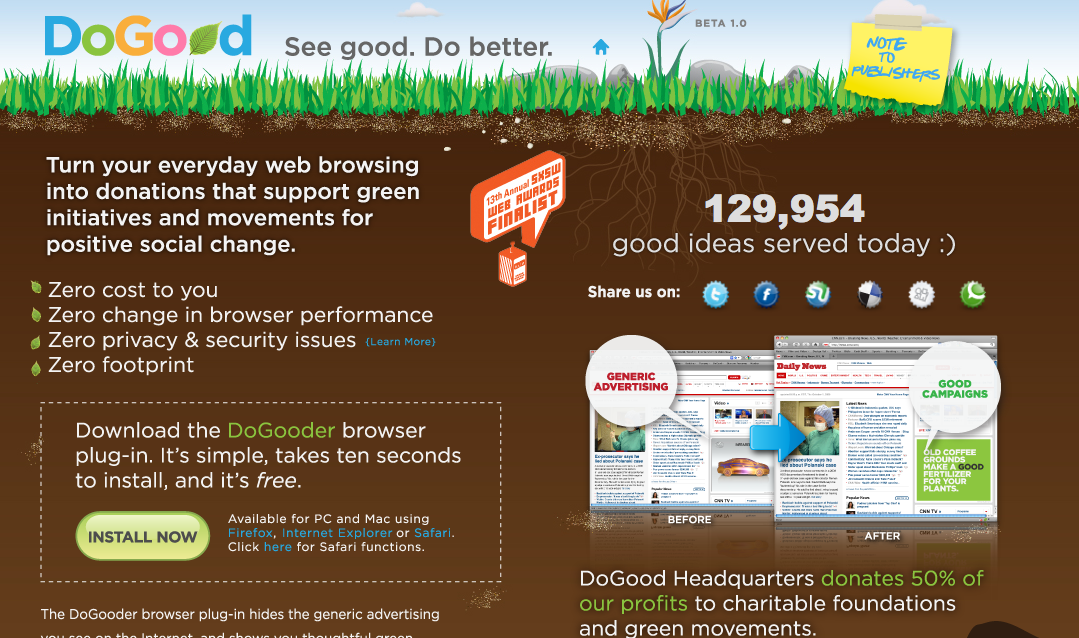
Enter DoGood Headquarters, a browser plug-in that “turns your everyday web browsing into donations that support green initiatives and movements for positive social change”. To date almost 130,000 plug-ins have been downloaded. This innovation has been featured in top blogs, including Tech Crunch and is in the running as a SXSW Web Finalist.
I had a chance to sit down with former colleague, Head DoGooder and Co-Founder, Faisal Sethi.
Hessie Jones (HJ): Tell me about DoGood.
Faisal Sethi (FS): DoGood Headquarters is a social enterprise in the business of doing good. We’ve created a free browser plug-in that allows anyone to do some good on daily basis without any effect on their lifestyles or bank accounts.
HJ: You are a designer/creative director by trade. What compelled you to do this? How did the concept come about?
FS: I have an academic background in sociology, and as a consequence, I was, and am, fairly aware of social / environmental issues and circumstance. But, I wasn’t really doing anything about them. It is very easy to acquiesce to the daily barriers keeping us from being active on a social level, so I set out to devise a solution to help alleviate some of those constraints.
HJ: Technically, what does the widget do?
FS: The DoGooder (generally) hides the generic advertising found on the Internet today, and shows end users campaigns related to green initiatives, philanthropic calls to action, non-profits, charities, and health and wellness ideas instead. We then donate 50% of the proceeds from said campaigns back to good causes, consequently turning everyones normal everyday browsing into a powerful funding tool for the greater good.
HJ: This is a huge disruptor for the advertising community who have paid thousands of dollars for premium placement online. How do you respond to content portals and media sites whose ad spots are being seemingly compromised?
FS: “Seemingly” is perhaps an appropriate semantic choice. Unlike ubiquitous ad blocker plug-ins, the DoGooder does not block ads, nor does it change the underlying code of a web page in any manner. Ads are still being served, and ultimately, can be viewed by the end-user at any time with the simple right-click of a mouse. Ultimately, the decision is up to them on how the choose to consume online media, including advertising. We think trusting the end-user is an empowering and novel idea. What I find interesting is that throughout history, it has been disruptive technologies that have perpetuated innovation, and ultimately allowed industries to grow in new and exciting directions.
HJ: Do you not see a legal issue overtaking legitimately bought placements and “stealing” impressions from advertisers?
FS: The issue of relevance in this context seems to be the right to use, and the legalities of, end-user technologies. There is this (general) notion that the Internet is this magical place in the clouds. The reality of the matter is that the Internet is tangible; made up of hardware, software, code and cables et al. As such, it too is bound by the mores, values and laws of the tangible world and our dominant capitalist infrastructure. In this context, not only do end users have the right to choose how they view the Internet through their own browsers and computers, technologies like the DoGooder are absolutely imperative to maintain some level of independence from the system in and of itself. On a pseudo-similar parallel, think back to Beta Max and VHS, or modern day PVR’s, or simply being able to put a sticky note on your copy of the New York Times with a note to your wife or husband before she reads it.
HJ: How have the portals or content sites responded to this?
FS: The general response has been positive. The reality of the matter is, the DoGooder will have little if any impact on portals or content sites bottom lines, but it will have a massive impact on the organizations and people of this planet that need it the most. End user’s response has been amazing, advertisers and brands seem to grasp the possibilities– good stuff all around really.
HJ: Would this not be a wake-up call to advertisers to display content that the user wants to see in sites where they navigate?
FS: For sure. I believe Google even iterated the notion that technologies like ad blockers could actually improve the quality and relevance of online advertising, thus improving an end-user’s browsing experience, and creating higher click through rates. We are already experiencing the latter.
HJ: The online display model is beginning to lose its effectiveness. The problems that Yahoo and MSN are facing is a result of where consumer mindshare is shifting. Do you see your model affecting the way people buy media or consumer mindshare? If so how would this change the current ad model?
FS: Absolutely. The general paradigm shift we are proposing is giving the individual control over what type of campaigns they consume; focus on the end user rather than the destination, focus on a smaller, more targeted group of people which eliminates a lot of the guess work for advertisers. This will effectively increase brand equity, loyalty and trust amongst a highly engaged, and technically savvy audience that will perpetuate brand awareness in a more natural and organic manner. It’s a substantial change to the current model, but a good one we think.
HJ: I see an opportunity to capitalize on consumer preferences ie to build a database of users with specific opt-in preferences based on messages they want to see: environmental, music, sports etc. Then use the data to display relevant ads based on user preferences. This will take a while to develop, let alone build awareness. What are your thoughts?
FS: We’re already on it 🙂 We’ve been working on several iterations and models that speak specifically to your points. I think it will take some time for these concepts / technologies to become accepted as the norm on both a consumer and business level, but it seems like a very natural progression to me for a system that is growing more and more end-user centric.
HJ: Can you tell me about your current opportunities to monetize DoGood?
FS: It’s really not much different than how current traditional media buys operate, both online and off. We sell impression space for a variety of banner sizes based on CPM and CPC models. We also offer sponsorship space on DoGood campaigns that display social and environmental statistics and messaging as well. The only caveat to our model is we donate 50% of our profits back to good causes, which really is the exciting part of this for all of us.
HJ: How do you see this progressing and morphing in the future?
FS: I think it will simply continue to grow. The model has been around forever, and I don’t see it changing dramatically anytime soon. I think we may see a continuing trend toward CPA (Cost Per Action) type models, but CPM and CPC will still be the bread and butter for the foreseeable future. I think collaborating with brands on larger campaigns related to specific causes will also be something that could happen for us as well.
HJ: What is next for DoGood?
FS: We’re looking at supporting more platforms, the mobile space, and some great partnerships. I’d tell you more, but then where would that leave the element of surprise? 🙂
HJ: We look forward to the next iteration of DoGood. Good luck at SXSW
I guess this would be a digital day in the life! It’s unfathomable how much business and communication has moved online in the past decade. Enjoy!

Created by Online Education

Digital Strategist, Marketer, Tech Geek, Start-up Junkie, Connector, Blogger/Writer, Cellist
 My Huffington Posts Harvard Business Review Read Write Web TED Talks Being Peter Kim