CHCanada Case Study: Behold the Fruits of Transparency and Engagement

This is a true story of social media success that didn’t take long to generate signs that it was indeed working. This is one of my best examples of following social media rules of engagement to work in the brand favour. The reason this success is so profound is because its marketing team, while well versed in utilizing online (search, display, affiliate) marketing to achieve clear ROI success, did not necessarily see social media as a venue to achieve similar results.

Columbia House was a traditional direct mail company, whose strong foundation of measurability, attribution and ROI were key pillars that drove its success for many years. Technology and industry changes ie the decline of music CD consumption…Apple’s introduction of the iPod… and the subsequent move to cheaper MP3 downloads, left the music industry scrambling to monetize artists and their music. This, in turn, necessitated Columbia House to focus more efforts on movie sales. Despite its long tenure and strong presence in the movie entertainment distribution business, it had also met with criticism from users in areas regarding claims of negative option, unfair shipping charges, and challenging customer service issues.

So a new company was started in Canada –> with a new business model that responded to many of these consumer claims in hopes of starting fresh, recruiting a new support base and migrating its loyal customer base. The new company launched November 2008 and its positioning has been evident on their website to this day: “CH Canada.com Welcome to the NEW Columbia House..You spoke, we listened…No more unwanted shipments..”

Initial social insights were conducted around the brand and its competitors in the weeks before launch to validate the new business model. What CHCanada discovered was a wealth of passionate conversation both positive and negative about the very topics (…and then some) that instigated the business change. Unlike traditional research, the comments were in social media spaces for the world to see… and remained unchalleged and unresponded. The company noticed, at the same time, the number strong advocate discussions that had gone unleveraged. What CH had realized was that a comment posted many months ago could strongly influence those who had seen the discussion for the very first time. These strong conversations could very well hamper a successful launch of the new business model. In addition, as is the plight of most Canadian subsidiaries, any strong changes implemented locally were still “blips” in the overall map and did little to positively impact the overall Columbia House brand…the US parent that still retained the original business model.

The key to ensuring a successful launch of CHCanada.com was to provide voice in the social sphere and prove to its customers that it had truly changed before it could hope to acquire new customers. So CHCanada began engaging in conversation. We quickly identified three forums where strong discourse existed about Columbia House. The most difficult efforts included confronting its detractors. Honesty, transparency, and humility were the order of the day. Applying this strategy has allowed forum members to welcome CHCanada to the thread. By letting forum members understand what CH had done to change, and by openly asking people for their honest opinions and questions, CH has been able to eventually build trust as evidenced by the length and tenure of each CHCanada.com thread—> all of them with a range of 700 – 1200 posts starting from as early as January 2009. Along the way, not all forum members were not so quick to welcome CHCanada with open arms. It’s not surprising they “googled” each of our names to validate who we were and what we were saying. From time to time we have been met with accusations of SPAM and have been banned from sites. But overall, our presence in key forums has made an incredible impact on CHCanada’s reputation, its organic search listings, and has resulted in ever increasing positive sentiment in favour of CHCanada vs. its US parent. This topic cloud is indicative of the positive consumer perceptions surrounding the brand.

septtopiccloud
Within a short period of time, CHCanada was able to translate its participation into strong business results. Rob Weatherall, Marketing Manager of CHCanada has indicated, “Entering into the realm of social networking I knew this was something that needed to be done but was quite skeptical what impact it would have on my business. Within a couple of months of launching our program with Isobar, I clearly saw the positive impact this media was going to have. Social networking not only provided an open line of communication with customers, it also provided a product/offer testing arena, an ever-ready focus group, a source of testimonials, and for this business – our highest value customers.”

Highest value customers –>traditionally resulting from strong customer relationship management but developed over a long period of time. Now imagine applying the same principles to social media and experiencing the same effects in half, or even a quarter of the time! Who would ever have thought that by talking to customers, marketers would be able to take out the guess-work of their initiatives or implications of their analytics reports . Ask the customers what they want and give it to them! It’s that simple. And they will come…..And they came in droves. CHCanada initiated a free-shipping promotion in September because its customers asked for it. The result: The company witnessed the highest single sales of the year, with sales equivalent to half the month of August.

And the success continues. Twtpoll surveys have become a strong crowdsourcing vehicle to gauge consumer preferences. Responses for surveys have been strong with momentum starting from the moment of posting. Social media has allowed CH Canada a very inexpensive test-and-learn vehicle for promotions. Varying test components has allowed CH to pull off another successful FREE shipping promotion of late: resulting in the second highest sales day of the year.

Rob Weatherall summed up his experience this way: “The best form of advertising is word-of-mouth – what better way to get your message out than through social networking. Without the knowledge, expertise and passion Isobar brought to the table, this business would most likely have continued to avoid, out of ignorance, what has turned out to be an extremely smart business move”.

Taking a quote from one of the fourm members, “while i haven’t ordered from chcanada in quite some time, i still frequent the thread and certainly appreciate the comments and inititiave shown by the chcanada staff. when is the last time you saw an amazon or futureshop/BB rep come in and ask us what we like? NEVER!! “
Another one says, “ I’m amazed at how much they try to make everyone happy & take in their input. They’re doing a great job at trying to get everything right.”
Mentos Campaign Proves the Value of Consumer Generated Branding

It’s becoming more commonplace to see campaigns that leverage the strength of the consumer’s viewpoint and deliver a spectacular product from a grassroots view. Mentos is among those that has succeeded in this realm.

Yonge-Dundas Square on August 13 was a scene of fun in the sun, with giant slides, gladiator challenges, and hilarious Sumo wrestling competitions. This was an adult fun park, conceived by Toronto resident, Danielle Lamarche, winner of the 2009 Mentos Campaign, “Make your World Go Rounder“.

Cossette was the agency responsible for this campaign. The premise: Make Your World Go Rounder was meant to be light-hearted and fun, and make Canadians smile by reminding them about life’s simple pleasures. According to Alison Neil of Cossette, “In the competitive and cluttered gum market we wanted to bring attention to a product feature of Mentos Gum, their roundness (the only round gum on the market), hence “make your world go rounder… we certainly consider this campaign to be non-traditional. We decided to develop an experiential/User Generated Content campaign to engage consumers, develop a dialogue with them and enhance their brand experience.”

Danielle Lamarche, who received a cash prize of $5000 summed up the day this way: “The event was extremely well received. An unbelievable amount of people came to the fun park. It was so well set up and had blow up games that even adults loved to participate in. It was steady all day and fairly long lines actually began to form after 6pm.”

Lamarche’s winning response : “Put up an Adult Fun Park in Dundas Square with blow up slides and more. We all want to be kids again!” Says Lamarche, “I really wanted to give a suggestion that would be something adults could do to let loose. I knew that it also had to the affordable and executable. It also needed to be an idea that could be Mentos Gum branded. I always watch out of the corner of my eye when kids play on the blow up toys these days and wish I was still able to do it as well. I’m sure many other adults feel that way so why not give them a chance to do it for a day?”

What does she think of the Mentos brand now? She sees a brand that tries to encourage positive thinking. “A lot of the responses that I saw were about giving to others, donations to charity, and making a mass audience happy. … People want to be happy and want to see the world become a better place. We’ve come to a time now where people are becoming much more aware of what is going on in the world and I think it’s important for brands to be aware and responsive to it.”

The campaign focus was the website: (www.makeyourworldgorounder.ca and http://www.pourquevotremondetourneplusrond.ca) but was heavily supported by out of home, transit, radio and web advertising. The latter also included social media accounts on Facebook, Twitter, YouTube and Flickr to support the contest, communicate the new line of products, begin developing brand loyalty, and help with Mentos Gum SEO.

The response to the contest was overwhelming. Close to 20,000 idea submissions in Canada were received.
According to Neill, “We feel that we’ve accomplished our goals of increasing brand awareness and communicating that Mentos Gum is a great, fun product that is close to consumers.”

In using consumer generated content to help fuel conversation, Neill agrees that UGC (User-generated content) works. Says Neill, especially ” when you listen to your consumers, participate in the dialogue and give back to them. We are big believers in experiential marketing at Cossette.”

Cluetrainplus 10: Thesis #89 We have real power and we know it. If you don’t quite see the light, some other outfit will come along that’s more attentive, more interesting, more fun to play with.

I have been privileged to take part in the 10th Anniversary of the Cluetrain Manifesto. I was made aware of and signed up for a blogging event in which 95 bloggers each write a post on the same agreed date, April 28th, about one of the “95 theses” from the Manifesto. Details about this event and Cluetrain’s history are found here. I will provide viewpoint on thesis number #89.

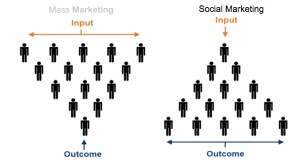
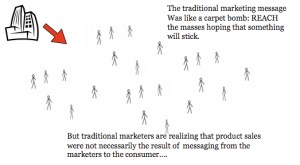
For years marketers like me have believed that advertising had the strength to influence consumer attitudes and behaviour. Advertising had more power when ad vehicles were few. As consumers, we were easy to get a hold of – we read the same papers, listened to the same radio programs, and watched the same television shows as everyone we knew.  Marketers had it easy…but it was rare for consumers to see an ad that was relevant to them. That was ok for marketers because 2% response rate or a break-even ROI was all they required to deem a campaign successful.

These days, technology has made it increasingly difficult to reach consumers. Media has become fragmented. Access profileration has allowed the consumer to be in multiple devices simultaneously including:  access from radio, TV, mobile, MP3s, search, print, billboards, videogames, IM, email, video consoles etc. Overlay the incredible explosion of the number of radio and TV channels, magazines, newspapers. This pace of change is making it increasingly difficult to pin target consumers down with a relevant message at the right place and right time.

traditional-engagement

It’s become increasingly apparent that the difficulty in reaching the consumer has been compounded over time. Access proliferation has put the consumer in control of how, when and what media they consume. At the same time these same channels are giving the tools to communicate to many people at a much faster pace. Universal McCann’s Worldwide Comparative Study on Social Media Trends, April 2008 indicates the growth of social media since 2006. Some highlights include:

  • 73% of active online users have read a blog
  • 45% have started their own blog
  • there are over 184 million bloggers worldwide, with approx. 1/4 from China
  • 57% have joined a social network
  • 34% post opinions about products/brands on their site/blog

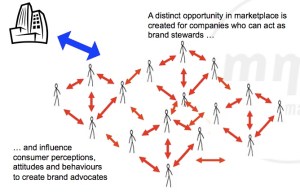
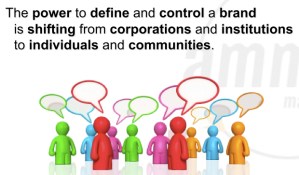
People are talking about brands to each other and surprisingly many brands are oblivious to this; or if they are aware,  they don’t realize the enormous impact it has to their reputation as a company.  The power shift from the corporation to the consumer is apparent. Advertising messages do not influence as effectively as marketers have always believed.

powershift

The very medium that divides the brand from the consumer also has the ability to bring them together. Consider this stat from the Universal McCann Study:  36% of active online consumers think more positively about companies that have a blog.  Start-ups have easily figured this out and from day one are leveraging the conversation with the consumers to help shape and evolve their businesses. They have figured out that unless they listen and respond to the market needs, there will be no market for their product or service offering. Coming from a start-up, the lack of big marketing budgets forced me as a marketer to really understand social media if I was to effectively drive reach:

  • Use the networks to bring awareness of your offering.
  • Engage with relevant target groups to help you fix the current bugs and improve your product over time.
  • Take it on the chin and be willing to accept the good with the bad.
  • Continually engage your consumers for feedback. Develop relationships and nurture them over time. Do NOT bail on your community.

Malcolm Gladwell’s “The Tipping Point” provides the best illustration of the power of conversation. He points out, ” I’m convinced that ideas …. move through a population very much like a disease does….Ideas can be contagious in exactly the same way that a virus is.”  It doesn’t take much effort to pass along a cool idea but the very nature of one idea being passed along from person to person can result in an epidemic. “The virtue of an epidemic, after all, is that just a little input is enough to get it started, and it can spread very, very quickly.”  In this way, the effectiveness of word of mouth begins to produce a clear picture of the power of the individual:

social-influencer

Dell found out the hard way how consumer opinion could negatively impact their business. Now, the emergence of Ideastorm, and Twitter engagement has catapulted the company into social media success and has effectively put their Dell Hell days behind them.

Customers talking about brands are making it clear what they want, how they want to be serviced, and what they consider good value for their dollar. The great thing for marketers is that engaging in these discussions limits the guessing game. Companies can now provide a product or service that the customer wants….what a concept!

Other top brands are getting on the band wagon and they are capitalizing as early adopters:

  • Starbucks Coffee created a site that allows users to submit suggestions to be voted on by Starbucks consumers, and the most popular suggestions are highlighted and reviewed. Their heavy presence on Twitter has also helped the company to disseminate information and gauge consumer opinion in real time.
  • Zappos and CEO Tony Hsieh have become known for embracing Twitter as an essential tool for exceptional customer service. Tony, himself, through his Twitter account has become accessible and has helped personify Zappos as a company who is friendly, trustworthy and helpful. Twitter is ingrained in the company culture..so much so in fact that the Zappos site aggregates the Twitter streams.
  • Ford Motor Company and its head of social media, Scott Monty have used the channel as a way to inform the public in real time of company happenings especially during periods of volatility. It was this kind of transparency in communication that helped quell much negative public opinion and, in my view, has helped elevate Ford’s brand presence above GM and Chrysler during the government bailout period.

So, for those brands that are afraid to dip their toe in this new conversation, who are afraid to engage with consumers, it will only be to their detriment.  Consumers will continue to speak about your company and your brand(s) with or without you. Social media is not a fad. It will continue to grow and evolve and as new devices are invented, conversation will multiply at alarming rates. The opportunity for big brands and businesses is enormous. Begin to engage in discussions at a peer level…listen and understand…develop important relationships…and build strong brand advocacy and a sustainable model in the meantime.

socialinfluence

Credits for this thesis go to P Furey and A Wong for some really cool slides I used from their presentations.

How Social Media Challenges Traditional Thinking

I often wonder what was the tipping point for social media? Why is it receiving more attention now than ever? It has always been there and those in the know — whether they are the tech savvy or the digital youth — saw its benefits much sooner than the rest of us.  But now it’s really gone mainstream:

  • Every radio station, newscaster, broadcast media has a Twitter account. My late night TV news station uses it as a crowd-sourcing mechanism to gauge immediate opinion on key news issues;
  • Charities/causes are popping up and its organizers are wising up to the fact that they can raise awareness and donations within hours of launching their campaign;
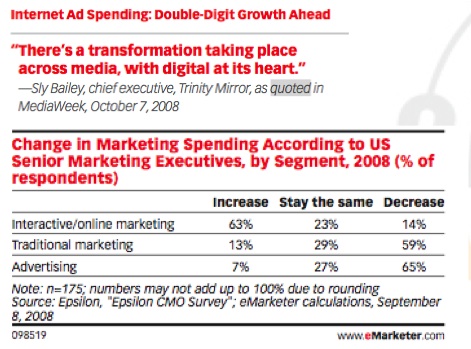
  • The newspaper industry is dying as consumers increasingly look online to find their news and information for free. As a result, a large scale shift in ad spend is expected in 2009 away from traditional print and broadcast to online. eMarketer verifies this transformation:

internetadspend-copy3

  • Marketers have been told that this channel not only offers true measurability but it results in strong customer engagement and sustainability;

For someone like me, whose marketing roots have evolved from traditional mass to direct and database; then to online display, search and now social media –> my profound learning comes in understanding that it is a medium that continues to evolve and has yet to establish standards for marketers. I continue to hear that no one should have the right to call themselves “social media experts” and while I believe that is absolutely true, I will place my bets with those marketers and organizations who are using this medium everyday to establish their brand, and create a true understanding of their customers.  These guys practice what they preach. Other industry notables have gotten their names because they’ve seemingly held the answers to a space that was virtually untravelled by the mainstream. But I have yet to see any validation of their preachings.

Could it be that the new US President Barack Obama will be known as a key instigator in bringing this whole notion to the masses by his very acknowledgement of the pervasiveness and influence of technology and its ability to shape consumer perception and build incredible momentum?  The strength of Obama’s campaign and his revolutionary move into office are based on the ideals set by the Founding Fathers: Election for The People and By the People…. and NOT by the lobbyists or constituents who have traditionally influenced policy and government spend. He has seemingly abolished this practice and has brought on a new idealism of transparency (as per the video: White House 2.0: Social Media and Government Transparency)

As I evolve Ammo Marketing in Canada, the social media space is exciting and yet daunting. I have been able to convince some clients that traditional research does not compare to the unfiltered, unmoderated insights they will get from social media. The very research has opened clients’ eyes who become keenly aware of the honest commentary on their brands: the good..the bad…and the ugly.  This immediately creates a sense of urgency to jump into the conversation and clarify misperceptions and diffuse detractor comments.  Little by little, participation in this new media is slowly revealing its true worth: as a true engagement device that leads to a sustained dialogue and eventual impact on revenue.

One of my staff came to me today and was so excited to be in a ground-breaking and evolutionary space.  As someone who supports client initiatives by participating in relevant discussions, she is delightfully surprised by the willingness of people to embrace corporate presence and engage with them peer to peer with no strings attached. It’s amazing how much people are willing to tell you if you give them the platform to speak.  The results we’ve seen have been immediate. But be warned, it will take some time to fulfill that ROI. Effort must be consistent and committed. Consumers will become your advocates if you continue to maintain that connection and you openly respond to their concerns.

Christopher Barger, Director of Social Media, General Motors (http://twitter.com/cbarger) said it best: Look for the return on conversation…not immediately…but when it comes it will sustain itself long-term.