The Full iPhone 5 Rumour Round-Up

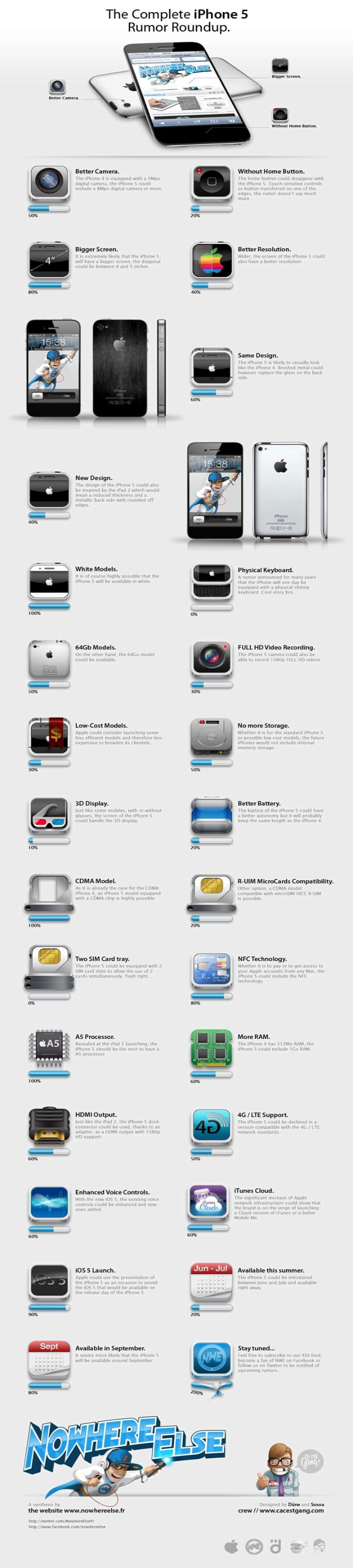
I saw this on Iphone Hacks and I had to put it up. This is the reason I’ve held on to my 3G and chose to forego the iPhone 4. This might be worth waiting for:
The Merging of Pure Play Media and Social Media

Why social rocks?

My first foray into social media some years back, I was confronted with a channel that seemed so vastly different than what I’ve come to know in my years as a digital marketer. I became enthralled with the notion of relationships driving business; with transparency and authenticity integral to delivering value. 
Willy Loman’s character in Death of a Salesman is about a man who is self-obsessed with the notion of greatness, and even in his later years convinces himself that success is directly attributed to “greatness, popularity and personal charisma”.

Contrary to that notion, many successful businesses have been built on a simple handshake, the unspoken trust built from years of understanding customers and responding to their needs. Customer relationships have been at the core of convergence. This is not new… but in the digital space, it is the absolute core to business sustainability.

And I have bought into that. I have come to emerge as a purist in social media and while I understand this continues to be a test and learn channel, I have not necessarily given up the principles that have accompanied the true merits of this channel: credibility, community, engagement and its undeniable result: sustainability.

Nowadays you can buy social… but that’s counter-intuitive to why social exists

In recent instances I have come into contact with social networks that have tried to sell me media across blog networks, consideration into networks with strong exposure to the long-tail audience.

While that piqued my interest, it became apparent that “access” to niche bloggers, particularly ones with influence, would really mean buying ads on their sites. There was no real opportunity to engage with these influencers, nor develop a really strong program to build brand engagement among the follower base. It was simply pure play media. The argument that comes back to me from the media sales guy, “…but it’s still media, and it doesn’t come free!”

The Quest to Monetize Social Networks

It seems to have been the age-old question. If these networks are to exist and be maintained, how are they going to make money? One of the reasons that Yahoo! reduced its investment in 360, Geocities, and Answers was that it struggled to combine online ads into a user-engagement environment ie the two environments could not effectively co-exist. Ad performance was poor because users didn’t want them there. There are some networks doing an ok job at monetizing the medium:

  • Google fortuitously recognized a subscription model that users were willing to pay for to help justify their acquisition of YouTube.
  • Slideshare and Scribd expect users to pay to maintain their presentations ie brand presence on its network. Downloads lead to business leads, hence the reason to be here.
  • The contextual advertising Facebook offers is very relevant to its members, however I don’t know how good the click-through rates are compared to traditional online media. I would suspect that the low CPMs indicate that it’s still not a pervasive medium to buy ads. I’d like to be proven wrong on this one. My friend at Facebook and I have had endless arguments about social ads and the oxymoronic way Facebook has chosen to monetize its network. I argue it’s still blatant advertising and it’s the reason people have gone away from the portal model ie Yahoo! AOL and MSN — to get away from the intrusiveness that has come between the user and his/her consumption of content.
  • Twitter’s model is, by no means, relevant to its users. Twitter ads run in the user’s timeline and does not target users based on profile, interest, tweets or followers. This article, states, “ We want to display Promoted Tweets in a way that’s both useful and authentic to the Twitter experience”. IMHO authentically spamming.
  • I’d be interested to hear what other people think. Do we expect that emergence of more ads in our social footprint will be accepted by users in the long run? Or will it necessitate yet another change that undermines this trend?

    The Segregated Internet: The Walled Garden that lives among an Open Source Internet Society

    A few weeks ago, a few friends of mine, Steven Taylor @stevenltaylor and Martin Byrne @mbyrne2323 had a philosophical and yet cynical discussion about this growing notion of the “Splinternet” which was initally coined by Doc Searles and Rich Tehrani. Thanks to Josh Bernoff of Forrester for bringing this back to light. He referred to a “Web in which content on devices other than PCs, or hidden behind passwords, makes it harder for site developers and marketers to create a unified experience.” Steve was the one who first brought up this notion of the Walled Garden. While it seems we’re playing nice in the sandbox, there are big players who are slowly creating a greater separation for the purposes of wielding greater control in a largely uncontrollable market.

    Social, while around for awhile, has been questioned by traditional marketers who need validation of its performance. What has helped unify social sites has been open source that allows the connectedness of platforms that have hoped would also provide more insight into consumer behaviour and navigation cross-platforms and channels. The notion of open source was sharing and allowing individuals to access multiple networks without relying on the management of multiple accounts. I have often parallelled this to the idea turning spaghetti into soup, where users go from site to site seemlessly, sharing same and new connections as they go and creating more bonded relationships.

    At least this is how I envisioned the insertion of open source…

    But Apple and Facebook, two extremely strong players are making it increasingly difficult to play nice. I’ve developed on Facebook pages and have experienced migraines at their ever-changing policies. Not to mention, Facebook code changes, implemented at the expense of the developer efforts and marketers’ investment dollars, are indicative of a communist regime that has no problems dictating policies, because they claim the population equivalent to the third largest country behind China and India.

    Things that tick me off:

    • Facebook,’s policies on doing Facebook Page promotions need the written consent of Facebook.
    • Facebook bends the rules for current advertisers.
    • Marketers are unable to run contest and promotions utilizing Facebook’s native tools — their wall, photo tags, video etc for fear or liability in the event of a malfunction on these tools. This is what really P’s me off. I have been told to build my own “wall”. Well Facebook, that defeats the purpose of amplification if my wall posts won’t be fed into the newsfeed.
    • Facebook Community Pages, which totally confuse the user, and draws attention away from the official page.
    • Google no longer has access to index all web content. Newscorp and Facebook do not disclose all their content to Google.
    • Newspaper sites that closed down their offline are moving to online paid subscription, therefore perpetuating this separation.
    • I know Apple’s been pretty much doing the same thing with HTML5 as the rest of us have gotten used to Adobe Flash.

    I actually love the idea of Open Graph that creates a social footprint for all web assets outside of Facebook or other social platforms. But that infers Facebook domination. Google watch out!  (another blog post methinks!)

    All this is happening while people like me are still trying to validate the channel. Standardization has still not happened. The IAB doesn’t know how to treat metrics, best practices, etc. The closer we get to creating a stronger community, the harder these companies are working to remove themselves from the mix.

    I guess in some ways, if truth be told, there needs to be a few that dominate. Does Apple and Facebook want to be the MSN and Yahoo! during their heyday? And what will happen to the true value of open source? I’m compelled to believe that the masses may demand some sort of conformity but I doubt that will wield any long term effects.

    So, I guess we’re witnessing the end of an era….however short-lived!

    Here is a recent video that explains this.

    Brands connecting with Moms: How social media can change the way brands purchase media

    I recently posted an article on Yummy Mummy Club that spoke about the difference between Advertising and Buying Consideration. You can find the post here: http://www.yummymummyclub.ca/brands_connecting_with_moms_hessie_jones

    When I initially wrote it I was frustrated with the way media companies were treating blog or community properties. They were selling advertising just like any other publishing site or portal. The model didn’t take into consideration programs that could be developed that allowed brands to begin the engagement with communities to build relationships. The ad-buy was was transient and short-term,  awareness-building at arms-length.  I think there is an opportunity to transform this model and allow a WIN-WIN that ensures the audience to speak and be heard and companies to listen, engage and provide what their consumers want.

    I’ve posted the article below as well:

    Right now, it’s the tail end of the NXNEi conference of Toronto and the Architects of Community session where Erica was a panelist. While she relayed her story about how Yummy Mummy Club evolved, she also presented insight into some of the real challenges she faces as a social media site.

    I’m here to provide a view from a brand perspective because I deal with them everyday. I want to also give you my view into how the social sites will evolve.

    Erica mentioned an experience where someone had expected to pay nothing for advertising on Yummy Mummy Club because social media is free. That is a hard perception to dispel, because for the longest time social media was about rolling up your sleeves and finding sites and groups that were potential prospects for your products or service. It wasn’t about advertising. It was about effort and building relationships.

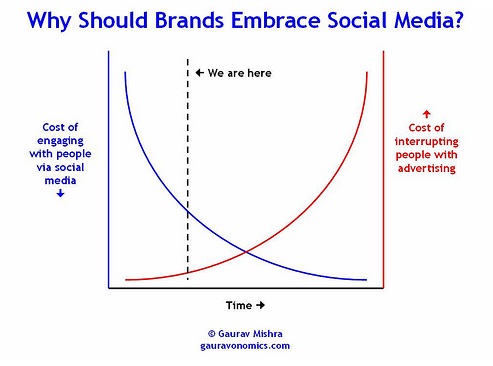
    The cost to buy media had been transferred into the long and arduous effort applied to reach out and build community. And that notion still holds BUT what has evolved is that now there is a price to pay for access into these engaged and tightly-knit communities. We need to dispel the myth that social media is free. Brands need to understand that it is not necessarily an advertising medium, but a way to begin to engage and build some brand consideration among groups they care about.

    And that is where I think Yummy Mummy Club can catapult this to a whole new level. Brands can always buy advertising: banners, emails, etc., but if they are looking to target social media sites they are going to get the incremental value in helping them build/tweak their products and services; providing real-time crowd sourcing opportunity that traditional media doesn’t bring; the impetus to build ‘real’ relationships that they can develop and sustain over time.

    So as a marketer, I want to work with Yummy Mummy Club to deliver value over and above advertising consideration. Moms know what they want. Moms know how they feel about brands and products. Moms are creative. Moms are engaging. Brands WANT to hear from you and they are willing to allow let their guard down a little bit, eat a little crow, and let people give them suggestions that may prove invaluable to them. And I am willing to help bridge that gap and get you closer to brands so you feel you have a partnership and your words are being heard.

    Please let me know your thoughts!