Twitter Aggregated: Commands, Best Practices, Strategies and Executions..it’s all here…hopefully

I am in the midst of providing indepth training for a client on Twitter. This is a “Get Started Version”. I’ve spent the last 4 hours researching blogs and document sites to provide me with this information. Here’s what I’ve come up with. If you have more info that’s relevant to newbies, please let me know and I’ll add it to this blog post.
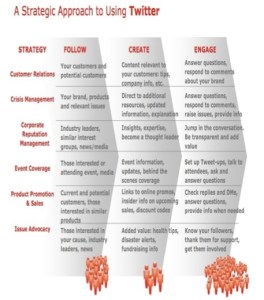
twitter-strategy1

Getting Started:

1)    Remember to create your profile in Settings:
•    Make sure your profile is complete. People decide to follow you based on the richness of your profile.
•    Make sure you upload a picture. It’s always nice to know who you’re connecting with.
•    Add a website URL  or better yet a blog or destination where you can invite conversation.

2)    Who to follow:
•    Use http://Twellow.com to target the users. This will depend on the account you created and the objective for the account. If it is to sell your product, then target people talking about your company, or products that your company offers.
•    Follow your friends first. Then look at their string of followers to determine whom you should follow.
•    Use http://grader.twitter.com to determine the top tweeps to follow — these are the influential voices in the twittersphere.

3)    What do I tweet?
•    Listen First: figure out what people are saying. Is there anything of value you can add? If so chime in.
•    Always provide value: is there information that you have first hand that you think would benefit others? Provide the link and let others know.
•    Emphasize another person’s tweet: if you think it’s important, then RT (retweet). This not only makes the other person appreciate that you’ve recognized their contribution, it also opens you up to further followers.
•    Promote your programs ONLY once you’ve created credibility: This is OK to do once in a while. If others see you have contributed valuable content, then the more likely they will come to your site.

4)    Tweeting long URLS: Since you’re constrained to only 140 characters, many times you need to use tinyURLS or similar functions to truncate your destination URL.  You can use your client Tweetdeck to shorten URLs before you post. It gives you more room to add some commentary to your post.

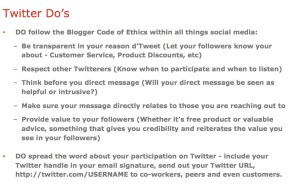
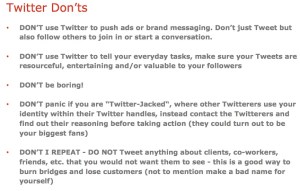
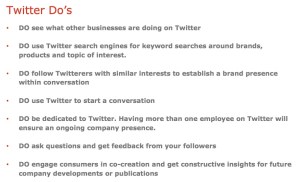
The DOs and DON’Ts:
twitter-do-s2twitter-do-s-2

twitter-donts

Potential Executions:

  1. Customer Service: Anyone who has customers – B2C, B2B can use Twitter to quickly listen and respond to customer feedback before problems escalate or to activate brand ambassadors…
  2. Crisis Management: Using Twitter for Crisis Communications is much about preventing an isolated issue from becoming a full-blown crisis as it is about communicating to the public once a crisis has hit. Twitter is a fast way to respond and maintain an open channel.
  3. Corporate Reputation Management: Twitter offers an outlet for your brand’s personality and humanity. A Twitter handle is created to share the brand personality from real-live people behind the messages being Tweeted. It’s easy to see what others are saying about your brand and the topics of interest and create a strong presence within those conversations.
  4. Event Activation: The real-time ability to connect with others and share experiences makes Twitter a great platform for individuals, or companies to use during a major event. Live-Tweeting an event can be used to create a completely new channel of conversation and a way to enhance the physical experience of the event. Combining Twitter with blogs, video and other social media efforts provides more ways to interact with the content and experience you’re creating
  5. Product Promotion and Sales – A successful sales and promotion plan is based on identifying your audience, providing useful content, and being prepared to engage in the conversation. When done right, your followers will become loyal, and also advocates for your brand and your promotions.
  6. Issue Advocacy – Twitter’s ability to connect people with similar interests can be harnessed for the greater social good with non-profits and issue advocacy organizations creating a community and providing useful information to those they serve, volunteers, donors and other supporters.

Commands:

From the web:

•    D username: sends a private message to a specific individual
•    @username: sends a public message to a specific individual; this message will archive in their replies tab, and be visible on your profile page
•    RT username: retweets content from another username. Use this function to amplify a specific message from someone you’re following.

From your Phone:

•    ON: turns phone notifications on
•    OFF: turns phone notifications off
•    STOP, QUIT: stops all messages to your device immediately
•    FOLLOW username: turns on notifications for a specific individual
•    LEAVE username: turns off notifications for a specific individual
•    D username: sends a private message to a specific individual
•    @username: sends a public message to a specific individual; this message will archive in their replies tab, and be visible on your profile page
•    WHOIS username: returns bio info for a Twitter member
•    GET username: returns the last update from a specific individual
•    FAVE username: marks the last update of a user as a favorite
•    TRACK word: returns updates from the Twitter community containing the tracked word
•    TRACKING: returns a list of words you’re tracking
•    UNTRACK word: stops tracking a word
•    UNTRACK all: stops tracking all words
•    INVITE 4155225678: invites a friend via SMS/text message to join Twitter
•    STATS: returns statistics

Essential Twitter Tools:

1)    Tweetdeck.com is the most popular client, using adobe air technology. Leave this on your desktop, instead of going to browser. Also these clients may be more accurate in seeing who’s replying to you. Through Twitdeck, you will be able to see four columns (or less) based on your preference:
–    posts from ALL friends
–    @ replies
–    favourites
–    Twitscoop ie Buzz trends on Twitter
–    Direct messages


2)    Search: Use http://Tweetscan.com
to see who’s talking about you, your brand, or a topic you’re interested in. Sign into tweetscan so you can can create searches by keyword and have the ALERTS sent to your email box, similar to Google Alerts. You can dictate frequency as well

Also, http://search.twitter.com/
searches Twitter by keyword. Initially, this was summize.

**For people who talk about your brand, it’s important to 1) follow them  2) respond to them on a timely basis

3)    Tagging Content: You can start to use the hashag “#” to add metadata around any tweet. This becomes more important as we rate and tag content. You can see the aggregated data on http://tweetscan.com . Here’s an example of #myfirstjob

4)    Alerts: Often, people will blog about the conversations that happen in twitter, the conversation shifts back to blogs. As a result, I setup Google Alerts for the phrase @hessiej or any specific keywords.

5)    Paste the Twitter Badge on your Site: http://twitter.com/badges — use a flash or html version of your twitter handle and post it to your website. Use it to aggregate traffic to your twitter page for e.g. dealing customer service issues real-time. Be careful — be ready to handle an inordinate amount of traffic.

6)    To specifically target users and categories, use http://www.twellow.com// . Twellow is a site which takes the geographical information and bio information from your Twitter account and uses it to categorize your profile. One of the great things about Twellow is it allows you to find people with similar interests who you can follow and interact with.

Enhanced Services:

1)    To take Twitter UP a NOTCH: Power Twitter :
Download the Firefox version. Here are the features:

-search – not on original twitter
-search scoped to a specific user
-status history peeking on mouseover
-Facebook status updates – as long as you’re logged in, it provides friends’ updates shown as status’ on Twitter
-inline YouTube, Flickr, and TwitPic – instead of URL, shows full pics, video which you can play inline.
-url expansion – allows you to see actual topic as opposed to greeked URL.
-url translation to page titles
-open web update (news feed) mapping

2)    View the latest tweets of upcoming trends on Twitter through http://twitterfall.com Updates fall from the top of the page in near real time. Unlike other Sites, this only tracks trends. The trends are listed on the left hand side of the page. Click on one to view the relevant tweets.

3)    Get the latest stats on the Top “Tweeps”,  Twitter Apps, Top Twitter Topics and Trends from http://tweetstats.com.

4)    FAVRD: most favourited tweets on Twitter. Search by keyword and see who else has favoured a particular tweet to identify like-minded contacts.

5)    See what’s hot right now on Twitter: http://www.twitscoop.com is a trendcasting service that aggregates the top topics on Twitter and presents them in a visually rich tag cloud. You can hover over each cloud to see a pop-up overview of the discussions around the topic or click through to dive deeper into the analytics of the conversation volume and duration and also participate directly. TwitScoop provides the ability to search keywords and usernames to analyze the dialogue and frequency behind them.. See it also on your client: Tweetdeck.

6)    http://twittercounter.com/ FIND TWITTER Influencers and level of activity: Provides an interactive chart that chronicles the quantity of Twitter followers for any given username. The results are viewable by week, month, and quarter and the service will also predict the future volume of followers based on the average growth/loss over time. The chart is embeddable as a widget on any profile, blog, or Web site.

7)    Share your photos on Twitter through http://twitpic.com/

8)    Twitterific http://twitterific.com A compact client that publishes tweets, shows unread tweets, has easy access to profile pages, shows either public or friend timeline, and more. This is a downloadable widget.

9)    Aggregation: http://Friendfeed.com puts all of our RSS content onto one page, making it easy to see from one glance (rather than going to different properties) and you can even reply from friendfeed to different tools. It’s smarter to organize around people, rather than tools. Add your bookmarks, facebook, myspace, and twitterupdates all in one interface.

10)    Measure the power of a user’s profile through http://twitter.grader.com/ . Just type in your username and get graded. The score is calculated as a percentlile of @users that have been graded. This is based on the number of followers you have, the power of the followers, the power of your updates, the completeness of your profile. Also use Grader to find the Twitter Elites — the top in your location and the Top Tweeps overall. Note, having an Elite follow you helps increase your ranking.

Please reference this link for other Twitter tools. It’s from Sociableblog.com.

Managing the Gray Lines of Reputation

I was intrigued by the following post from Peter Kim’s Reputation Matters. At its core the post makes sense indicating that your online conduct, who you associate yourself with and how you engage in those relationships have a strong bearing on your credibility. I agree that your number of followers is not a correct measure of your credibility but the quality of the relationships you’ve built with your network.

The quote that caught my attention from Peter Kim’s post was: “Thus we require personal interactions to help bridge the trust gap. These consist of content and quality within direct conversation. Recency and frequency matter here which should temper the “monetary”/intangible risk of any action. Behavior bundles in here as well.” In a space where relationships have been traditionally built through honest and authentic interactions, this should ideally be the norm. But we have to realize that this space is changing everyday. Marketers are starting to see the true value of social media and the wealth of brand conversations and opportunities to engage with customers will set the ground for another wave of change.

This leads me to Peter’s response to sponsored posts in which he said, “I believe that monetization leads to loss of objectivity sooner or later.” He referenced David Charbuck’s post entitled “Shooting Fish: Blog Sluts”. I read David’s post and I think he has polarized the view of bloggers. It’s nice to idealize a world where writers/bloggers have integrity and do not, in any way, prostitute themselves for the almighty dollar. The reality is that it happens with the emergence of the blogs. Everyone has forever been trying to figure out the monetization of new media and inevitably 100 ideas will unfold and a handful will be tried. Writing used to be a profession, a craft that required strong skills that were honed overtime. Today’s reality is that everybody and his brother can easily create a blog and can, with the plethora of social tools, spread their own messages to the world. That being said, Social Media 101 has provided some rules about acceptable behaviour.

This space is continuously evolving and the new media is now the sexy new channel that’s enticing to marketers because they’ve been told it’s a great way to engage directly with your customers, get immediate feedback, and build long-lasting relationships. Social media proliferated in an effort to flee spaces where advertising dominated. Now, it’s not so easy to hide from the throws of the large corporate dollar.

As a marketer I counsel clients on the value of social media to their brand but I also make them aware of the DOs and DON’Ts and the rules of engagement. The spiralling economic conditions are drawing more companies to this space to begin figuring out how to manage their reputation and start engaging with their customers. The reality is that ROI and defined timelines do not create the luxury of time to engage and develop these relationships from scratch. In most cases, companies need the help of influencers to help them make those introductions and accelerate those messages.  But those relationships have to be real from the beginning. I agree that “money” cannot play role in the relationship.  The friendship has to evolve naturally. But introducing marketers to influencers can evolve into trusting relationships, even if the initial introduction was to to help drive business. The influencers I have reached out to must, on their own, believe in and buy into the vision and activities of the advertiser. It is incumbent upon the influencer to walk away from the initiative if he cannot authentically and sincerely advocate the advertiser’s brand.  It’s not clear black and white. What I’m seeing today as a result of the initiatives we’ve created, are true relationships beginning to form between influencers and advertisers. That is also helping fuel the positive conversations about the brand and change perceptions in the meantime.

The true social media advocates have to also evolve as this space evolves. Understanding where to draw the line has to be taken on a case by case basis. Your actions will be scrutinized and your reputation will be judged by others but ultimately if you conduct yourself with integrity even your loudest detractors can’t fault you.

I love my Moo

What do you get relatives for Christmas who have spent many years accumulating everything under the sun? Who want for nothing in particular? And who don’t fancy any of the new electronic gadgets or games that technology offers?

I stopped guessing and realized that what most grandparents (I am assuming ages 65+) want is time in a bottle: the luxury of capturing precious moments and recording them and keeping them forever. We have the luxury of having a close family so we spend a lot of time together. But there are so many recorded moments, but not enough picture frames, and little time to print and stuff them all in photo albums.

So this year I decided on something different: I have always loved Moo and their unique concept in business cards. They’ve always been a conversation piece when I’ve distributed mine, and consequently, I’ve been able to create Moo-converts in the process. So, when the Mosaic frame came out, I went to town and started going through all my digital photos and picking out the perfect pictures to fill up the frame.  The grandparents just loved it because it captures all the important events that happened this year — all in one frame.

dscn0998

dscn09974

I saw a bunch of other ways people have used these Moo cards.  Here’s another one I love: It’s from LUZIEyear. Just fab. Thanks Moo!

Adapt or Die: The current economic crisis creates a much harsher picture of what lies ahead in 2009.

I read a pretty compelling, albeit morbid, email the other week from Jason Calcanis, founder of Mahalo.  He spoke about “The Start-up Depression” in the wake of current economic conditions in the US. He followed up with an equally forceful article titled, “Good News for People who Hate Bad News“. It sounded more like Armageddon was imminent. His words were harsh and foreboding:

The severity of what has happened can’t be underestimated. There will be no white knight. Even the massive coordinated government action–including the first global rate cuts and bail outs–has done nothing to stop the panic or create a bottom (at least from where I sit). Bottom line: there is zero chance of a short or medium term-rebound.  Zero.

It’s clear that he’s not overexaggerating.  Market conditions are impacting investing. Here are some harsh realities:

• Just yesterday, Tim Hortons has decided to close many of its stores in New England citing lackluster performance.
• The big car giants are rationalizing big time and talks of merger between GM and Chrysler come out of a necessity to survive. It’s being felt close to home as families in Oshawa – mine included – are shaking their heads wondering where it all went wrong. In past economies these institutions have taken care of their employees, where you were seemingly guaranteed employment until you retired. The union would fight for the best benefit packages for their workers and the carmakers acquiesced – all at the expense of the company’s eventual survival.  The funny thing is that GM, Chrysler and Ford’s  market share was  being taken away from the foreign competition AND their business did not adapt, let alone, anticipate what this could mean in times of serious downturn. And now they’re scrambling.

• Banks are going to feel a softening in credit sales, and mortgage services. Credit card companies,  which would traditionally promote low introductory APR for 6 months don’t have the luxury of making these offers today. Mortgage rates will be at prime plus for the time being. Banks have no choice but to secure existing investments and mitigate risk.  This “Death Spiral” as Jason Calcanis’ labels it, will impact consumer spending, so consumers will become much more aware of reducing their debt → the very necessity that have kept financial institutions going……until now.

• I went to the mall the other day and took a chance to observe. There were sale signs in many of the stores but the prices were not indicative of perceived discounts. Traffic to individual stores was pretty light. I noticed my favourite place, “Linens and Things had closed up shop – it had recently gone bankrupt — and a few more smaller shops had popped up in its place … a glimmer of optimism or maybe foolish hope?

There are those that equate today’s crisis to the Depression of the early 30’s. I don’t know if the coming year is going to be as doom and gloom as everyone predicts. I agree that people and companies will tighten their belts and look to create efficiencies, and produce more with less resources.  While it’s upsetting to even think about how the jobless will make ends meet in a survival-of-the-fittest economy, I have to wonder about those who are fortunate to have secured their jobs. What kinds of pressures will they have to endure as they are forced to do the job of 3 people and continue to meet their performance goals, which probably will remain unchanged?

Businesses will have to start developing strategies that speak to these challenges. To sustain in these trying times, companies will need to create stronger efficiencies while not risking the health of their employees or business.  Here are a few areas that I foresee businesses adapting:

1.  Spending on accountable and measurable channels needs to be a primary focus. Metrics will validate performance and channels that can provide true attribution on a CPA and CPC will see an influx of traffic.  This means increased online spending.  But media companies be warned: you’ll need to prove out channel performance and provide increased optimization strategies to win your clients and keep their business.
2.  Search Engine Marketing will see an increase in business mainly because budgets will have shifted from traditional branding channels and because search conveniently relies on consumers who are already engaged within the purchase cycle. It’s also a channel that’s highly measurable and much more efficient dollar for dollar compared to offline or even online media.
3.  Search Engine Optimization is an absolute must for businesses with an online presence. You need to ensure that your site ranks high on search engines and can draw tons of relevant organic traffic. This will be especially important for companies who have low marketing dollars to spend.
4.  Social media marketing will begin to see more traction in the coming year simply because it’s very much a nascent space and there are no standardized ad practices or industry rates that have been established.  The state of the economy will push more consumers online → the social sphere will see incredible growth as consumers become involved in information exchange and conversation. The organic nature of this space provides a large spectrum for brand building and influencer programs. It’s still relatively inexpensive but also highly measurable, providing strong qualitative and quantitative data to prove its value.
5.  Retention will be tantamount to acquisition. The low-hanging fruit for most companies will be retaining their existing customers. This can be done through email and existing customer touch points: telephone, retail (where applicable). Stronger customer service will be just as important to mitigate churn.
6.  Vendors will play a more significant role in client businesses. Companies who have downsized will increase their reliance on vendors to make initiatives happen. It will be more important for vendors to step up, provide the additional attention to their clients and work harder to own the results as much as their clients. I see somewhat of a shift developing in these relationships as a higher degree of trust creates more of a partner mentality.
7.  Bartering will become more prevalent. This is how original deals were created. Creating true value exchange between companies and a resulting win-win scenario can help companies through the rough cycles, and potentially develop enduring and profitable relationships.

Perhaps riding out this storm smartly will give companies some clear guidance in managing a future of uncertainty. Perhaps, it’s a lesson for all of us: Count your blessings now ’cause nothing is forever.

Here is a video I found with Bugs Bunny. It is a true metaphor for “The Death Spiral” we’re currently facing: